
How to Check Criminal History in Castro County
Castro County has no single file or complete public portal that answers every criminal-history question. Begin with the event you are trying to confirm. A felony case belongs at the District Clerk, a Class A or B misdemeanor generally belongs at the County Clerk, current local custody starts with the sheriff, and a city citation may sit in a municipal court. The re:SearchTX platform can add electronic access when a clerk participates and the account's access level permits it, but a blank result is not proof that no local case exists.
Gather the full legal name, spelling variants, an approximate date, and the case or booking number when known. Date of birth can help an authorized custodian distinguish people with similar names, but a name and birth date still do not provide fingerprint certainty. Use this order to keep the record layers straight:
- Ask the District or County Clerk which court level would hold the filed charge.
- Check the sheriff for current booking or custody and the arresting agency for its incident report.
- Use the Texas DPS public name search for publicly disseminable statewide cycles, then compare identifiers.
- Read the clerk's docket and judgment to learn the filed charge, disposition, and sentence.
- For your own complete identity-based review, follow DPS fingerprint instructions and challenge errors with source documents.
Castro County Criminal Records in Room 101
Castro County's courthouse puts both clerk functions at the same published counter without merging their legal duties. The District Clerk and County Clerk list Room 101 at 100 E. Bedford Street in Dimmitt, phone 806-647-3338, fax 806-647-5438. Their posted hours are Monday through Thursday from 8:00 a.m. to 5:00 p.m. and Friday from 8:00 a.m. to 2:00 p.m., including lunch. State the court level and document you want so staff can route the request instead of treating “criminal record” as one product.
The official Castro County homepage shows the building and current county contact block.
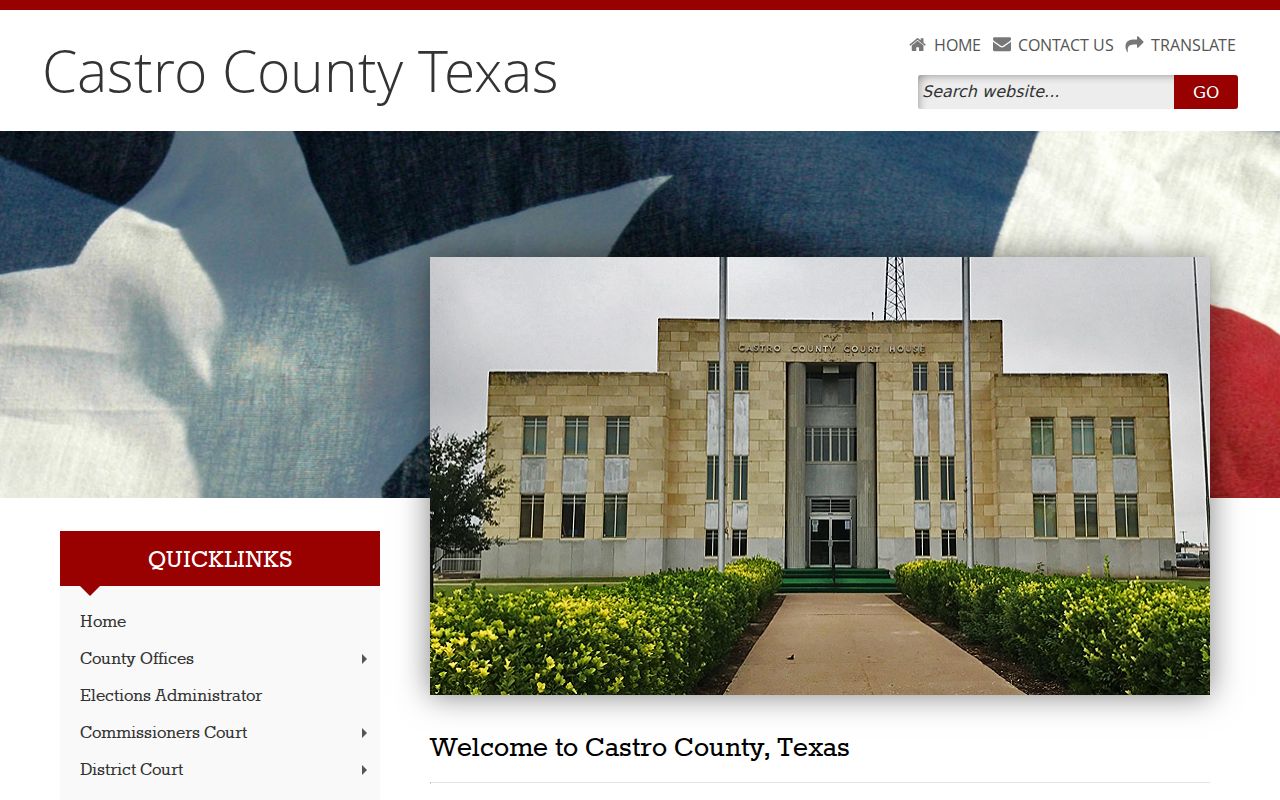
The county screen is a starting point for the right office, while the requested clerk file supplies the actual docket, orders, and judgment.
District and County Clerks
100 E. Bedford St., Room 101
Dimmitt, TX 79027
806-647-3338
Justice of the Peace
100 E. Bedford St., Room 201
Dimmitt, TX 79027
806-647-2328
Castro County Sheriff
900 E. Bedford St.
Dimmitt, TX 79027
806-647-3311
Official Texas Background Checks
The Texas Department of Public Safety, not Castro County, maintains the central Criminal History Record Information repository. Its Crime Records Service Criminal History Conviction Name Search offers publicly disseminable Texas conviction and deferred-adjudication information through an account and purchased credits. The product is not certified, is narrower than a subject's fingerprint-based record, and can return possible matches rather than a fingerprint-confirmed identity.
For your own Texas record, follow the DPS personal-review procedure and use FAST through IdentoGO with the service information DPS supplies. No stable FAST enrollment site was verified inside Castro County, so use the scheduler to search from ZIP 79027 and confirm the current site, date, access details, and fee. The official IdentoGO scheduler illustrates the service-code gate.
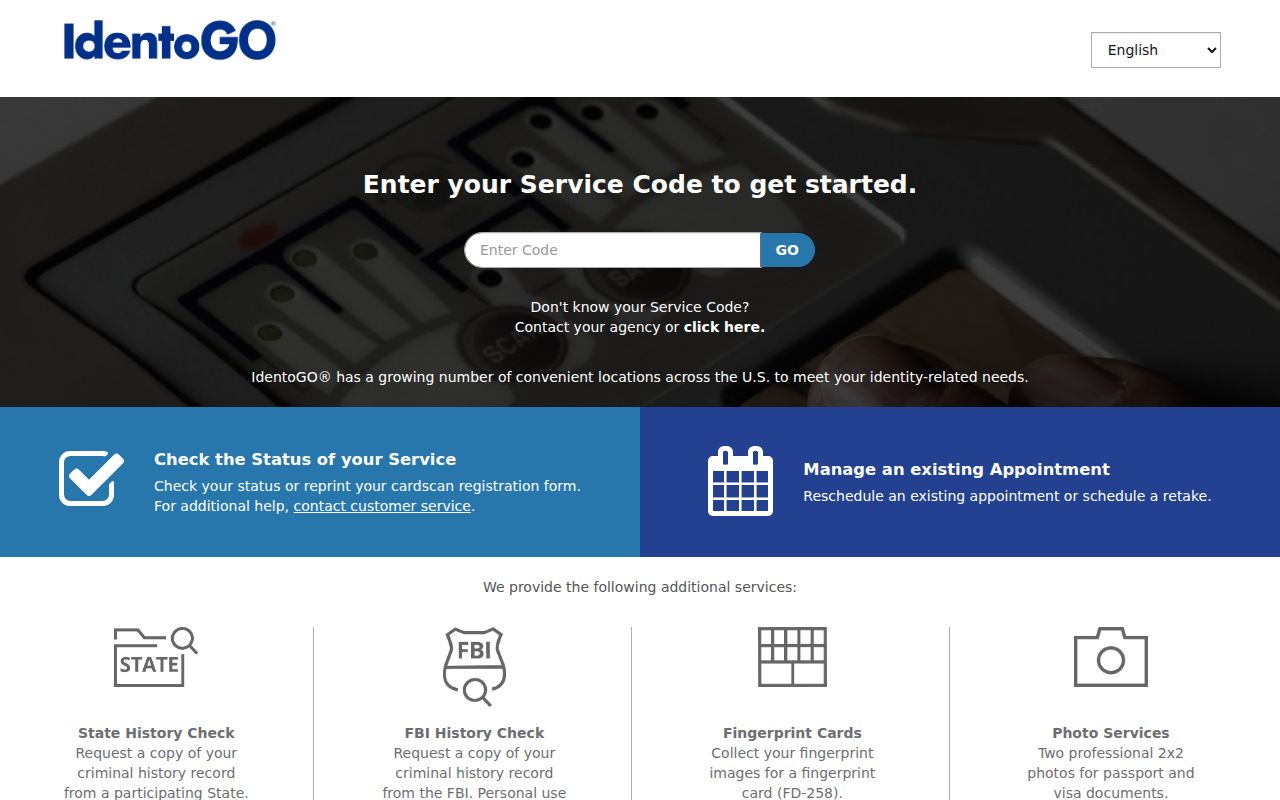
The appointment screen supports fingerprint capture; it does not replace the DPS instructions that identify the correct personal-review transaction.
| Official channel | Identity basis | Scope and verified cost status |
|---|---|---|
| DPS public CRS | Name and descriptors | Publicly disseminable Texas CHRI; credits are $1 each, with published card processing charges |
| DPS personal review | FAST fingerprints | Your own Texas CHRI; current transaction total appears in the authorized workflow |
| FBI Identity History Summary | Fingerprints | Your FBI-maintained summary; FBI fee is $18, while a channeler may add a fee |
| Castro County clerk | Name or case number | Cases in the selected local court; local search and copy charges are not published online |
Castro County Records and DPS Name Matches
A DPS public search reaches beyond Castro County, yet it does not promise a complete Texas rap sheet. Create an account, buy credits, and review each candidate before opening more detail because portal rules can consume a credit even when a search returns no match. Common names, aliases, an incomplete birth date, and reporting gaps can all affect the outcome. When identity matters for your own record, fingerprints are the positive matching method.
| Search control | Use | Matching caution |
|---|---|---|
| Last name | Required legal surname | Check spelling and aliases |
| First name | Required given name | Name alone is not identity proof |
| Middle name | Optional narrowing field | Useful when candidates share names |
| Date of birth | Expected identifier | Confirm the live format and compare carefully |
| Sex and race | Portal-dependent filters | Descriptors narrow results but are not fingerprints |
If a Castro County disposition is missing, obtain the clerk's filed judgment before using the DPS challenge route. DPS cannot create a source-court outcome that was never reported, and a local clerk cannot correct an unrelated repository cycle without the required process.
Types of Criminal Records
Each Castro County record reflects a different step and custodian. An arresting agency writes the allegation and enforcement narrative. Jail staff create the booking entry after delivery. A magistrate records warnings and bond action. Prosecutors and clerks then create the filed charge, docket, orders, plea, judgment, and sentence. Texas DPS connects reportable arrest and disposition data in its repository, while TDCJ maintains state imprisonment and qualifying supervision information.
- Incident or arrest report
- Agency account of the event, observations, alleged offense, and enforcement action.
- Booking record
- Jail intake data, received charges, fingerprints, bond, property, custody, and release fields.
- Court case file
- Filed charging instrument, docket activity, orders, plea, disposition, judgment, and costs.
- DPS CHRI cycle
- Identity-indexed Texas arrest and reported prosecution data, with a narrower public view.
- Warrant record
- Court-issued authority and service status, subject to limits for sealed or juvenile matters.
- Supervision or registry record
- Court, CSCD, TDCJ, parole, or DPS registry information governed by its own access rules.
The source determines what the result can prove. A booking is not a conviction, a warrant is not a finding that its allegation is true, and a registry profile has a specific public-safety purpose rather than serving as a general case history.
Castro County Courthouse Record Timeline
The records counter operates inside the county's third courthouse. Castro County reserved its courthouse square when the county organized in 1891. Lightning and fire destroyed the first permanent courthouse in 1906, a domed brick replacement followed in 1908, and the present stone Works Progress Administration courthouse opened in 1939. The Texas Historical Commission announced in April 2026 that it became the first Castro County property listed in the National Register of Historic Places.
The Texas Historical Commission marker record documents this courthouse sequence.
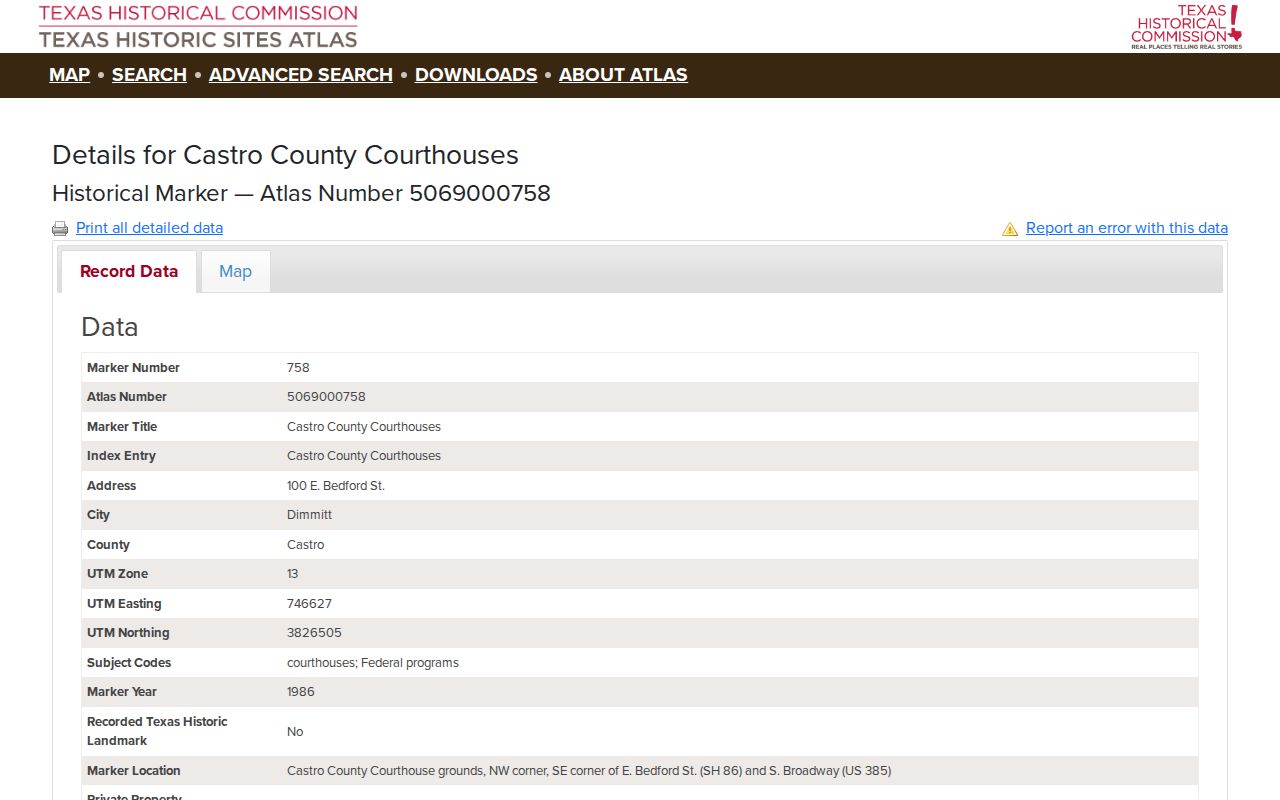
That history matters to a record search because older Castro County material may be stored or indexed differently from a current electronic docket. Ask Room 101 where its electronic index begins, whether an older file is on site, and how long archive retrieval may take.
What a Castro County Criminal Record Shows
No single Castro County result displays all fields below. The clerk file normally provides the richest account of the filed prosecution, while the booking entry captures intake and the DPS cycle connects reported events across Texas. Compare the case number, court, dates, and charges before assuming two screens describe the same matter.
| Name and identifiers | Names, aliases, date of birth, physical descriptors, and identity numbers where release is authorized. |
|---|---|
| Arrest and booking | Agency, date, booking number, intake charge, warrant, bond per charge, and custody or release status. |
| Filed case | Case number, court, judge, offense, statute, degree, attorneys, docket events, and hearing dates. |
| Disposition | Plea and outcome such as conviction, acquittal, dismissal, deferred adjudication, or no-bill. |
| Sentence | Confinement, fine, financial obligations, restitution, and community-supervision terms shown in the judgment. |
| Restricted fields | Victim, juvenile, personal, and confidential identifiers may be redacted or unavailable to the public. |
A charge label can legitimately change as the case moves. The arresting officer records an intake allegation, the prosecutor chooses what to file, and the judgment states the final result. Read the judgment rather than treating the first label as the last word.
From Castro County Booking to DPS Records
A reportable Castro County arrest starts more than one record stream. The arresting agency keeps its report, jail staff take identifying information and fingerprints, and the arrest transaction reaches DPS with a tracking control number. A magistrate handles warnings and bond matters. Later, a prosecutor may file an information or seek a felony indictment, and the responsible clerk opens the case.
Agency report → Jail fingerprint → DPS arrest cycle → Court filing → Reported disposition
Clerks and prosecutors report the outcome so DPS can attach it to the arrest cycle. Low-quality or missing fingerprints, identity mismatches, delayed reporting, and cases without matching arrest transactions can leave gaps. A dismissal does not automatically erase the agency report or booking record, and it does not make every person eligible for expunction.
Public Access Laws
Castro County agencies apply the Texas Public Information Act to existing non-exempt information they maintain, while courts follow judicial record rules, redaction law, and clerk procedures. A public request should identify a specific record rather than ask an office to research a person's whole history. Active investigations, confidential CHRI, juvenile material, victim information, and protected identifiers can limit release.
Key Texas authorities:
Government Code Chapter 552 gives access to public information and sets response and cost procedures, subject to exceptions.
Government Code Chapter 411 controls CHRI confidentiality, public dissemination, authorized access, and nondisclosure.
Code of Criminal Procedure Chapter 55A defines Texas expunction eligibility and record treatment.
Code of Criminal Procedure Chapter 62 governs sex-offender registration, verification, and public information.
A written sheriff request can be mailed to 900 E. Bedford Street after a phone call confirms the custodian. Ask for electronic copies and an itemized estimate before chargeable work. If estimated TPIA charges exceed $40, state cost rules generally require an itemized statement. The often-cited ten-business-day period is not a promise that every record will arrive in ten days.
Castro County Warrant Records Without a Portal
No official Castro County public warrant list, most-wanted page, municipal warrant search, or app was located. A safe check starts with the issuing court and the sheriff rather than an unofficial people-search site. Call the sheriff at 806-647-3311 about sheriff-executed warrants or current custody. Ask the clerks at 806-647-3338 whether a district or county docket shows a capias or bond event, and use the Justice of the Peace at 806-647-2328 for matters within that court's authority.
Dimmitt Municipal Court can confirm its city-case status at 806-647-2155, but its official instructions say a phone call is not a legal appearance. Hart Municipal Court lists 806-938-2171 and cityhart@amaonline.com. A written public-information request may obtain releasable sheriff-held data, yet it is not a real-time warrant-clearance method. Sealed warrants, juvenile matters, and unexecuted sealed indictments may remain unavailable.
Note: Confirm the issuing court, case number, warrant type, and approved appearance instructions before acting on a warrant entry.
Sealed, Expunged & Restricted
Texas juvenile law-enforcement and court records are generally confidential, with statutory exceptions. Public files also omit or redact Social Security numbers, driver's-license data, financial details, victim identifiers, protected addresses, and other sensitive information. Active law-enforcement material can be withheld under the Texas Public Information Act when release would interfere with detection, investigation, or prosecution, although basic information may still be public in some circumstances.
Expunction under Chapter 55A is stronger than an order of nondisclosure. Expunction can direct agencies to remove, return, destroy, or otherwise handle eligible arrest records under the order. Nondisclosure restricts ordinary public dissemination but preserves access for authorized criminal-justice and listed licensing entities. Eligibility turns on the outcome, offense, waiting period, and disqualifying history. A dismissal alone is not an automatic guarantee of either remedy.
The Castro County District Clerk publishes an expunction-agency list, but the court must first issue a valid order in an eligible case. After relief, a stale vendor copy or an incomplete DPS update should be addressed through the record holder's correction process, not by assuming every system changed at once.
Castro County Custody and Supervision Records
Local jail, state prison, federal custody, probation, and parole are separate searches. Castro County publishes no official jail roster, so call the sheriff for current local confinement and use VINELink only as a participating custody-status and notification supplement. The TDCJ Inmate Information Search covers sentenced state custody and certain state supervision information, not someone held only before trial in Castro County.
The Texas Board of Pardons and Paroles explains the authority that makes release-related decisions.
Board information answers a different question from the public Castro County judgment that imposed a sentence.
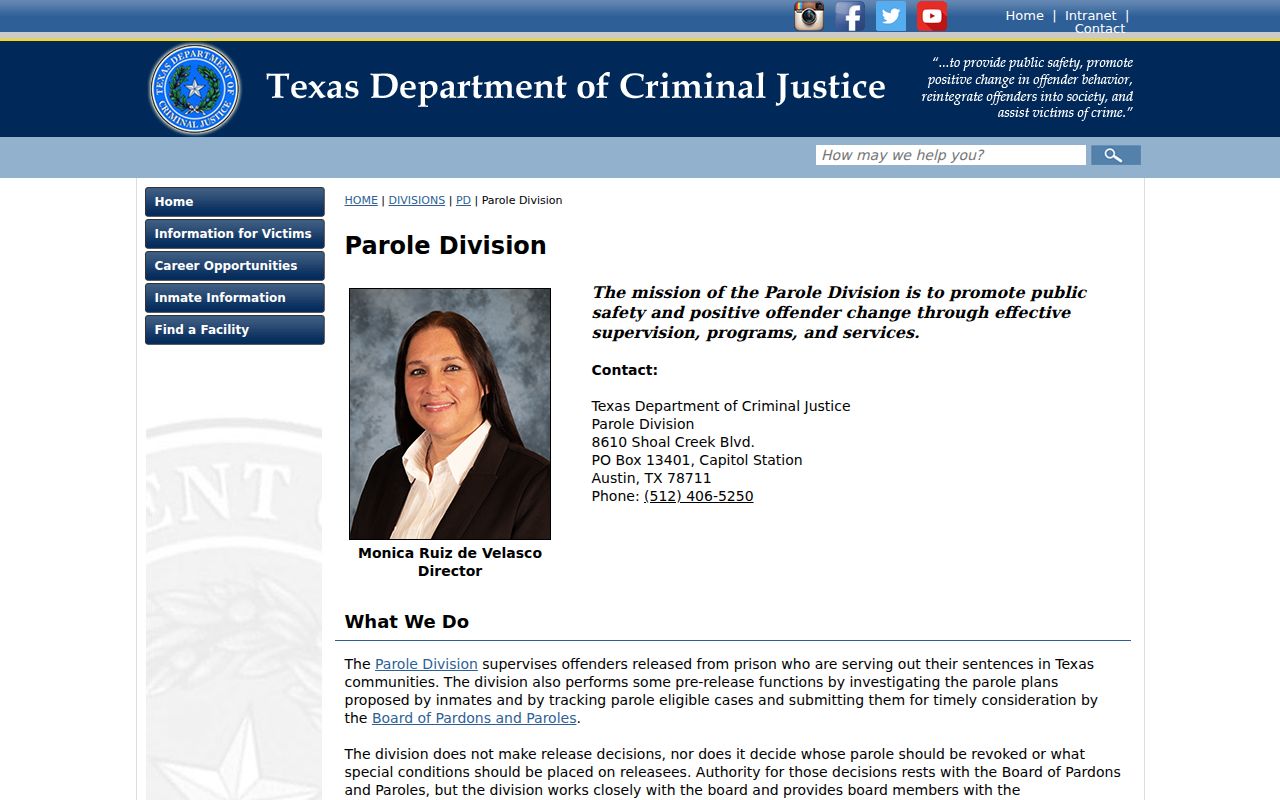
The TDCJ Parole Division page identifies the agency responsible for parole and mandatory-supervision field work.
For community supervision, the clerk judgment may show the public term while the 64th and 242nd Judicial District CSCD keeps operational details that should not be assumed public.
Criminal Records by City in Castro County
Dimmitt, Hart, and Nazareth are Castro County's three incorporated cities by the 2020 Census ranking. City boundaries matter because a police report stays with the agency that created it, a municipal case covers only that court's authority, and a later booking or felony filing can move the search to county offices. Each city guide begins at city altitude and then points to the sheriff or courthouse only when the record leaves the city system.
Dimmitt Criminal History
4,171 residents · Verified police and municipal court counters, with no public case-search portal.
Hart Criminal History
869 residents · Municipal court requests run by phone, email, fax, or mail.
Nazareth Criminal History
311 residents · No current state court-directory entry or city records portal was found.
Federal Records Beyond Castro County
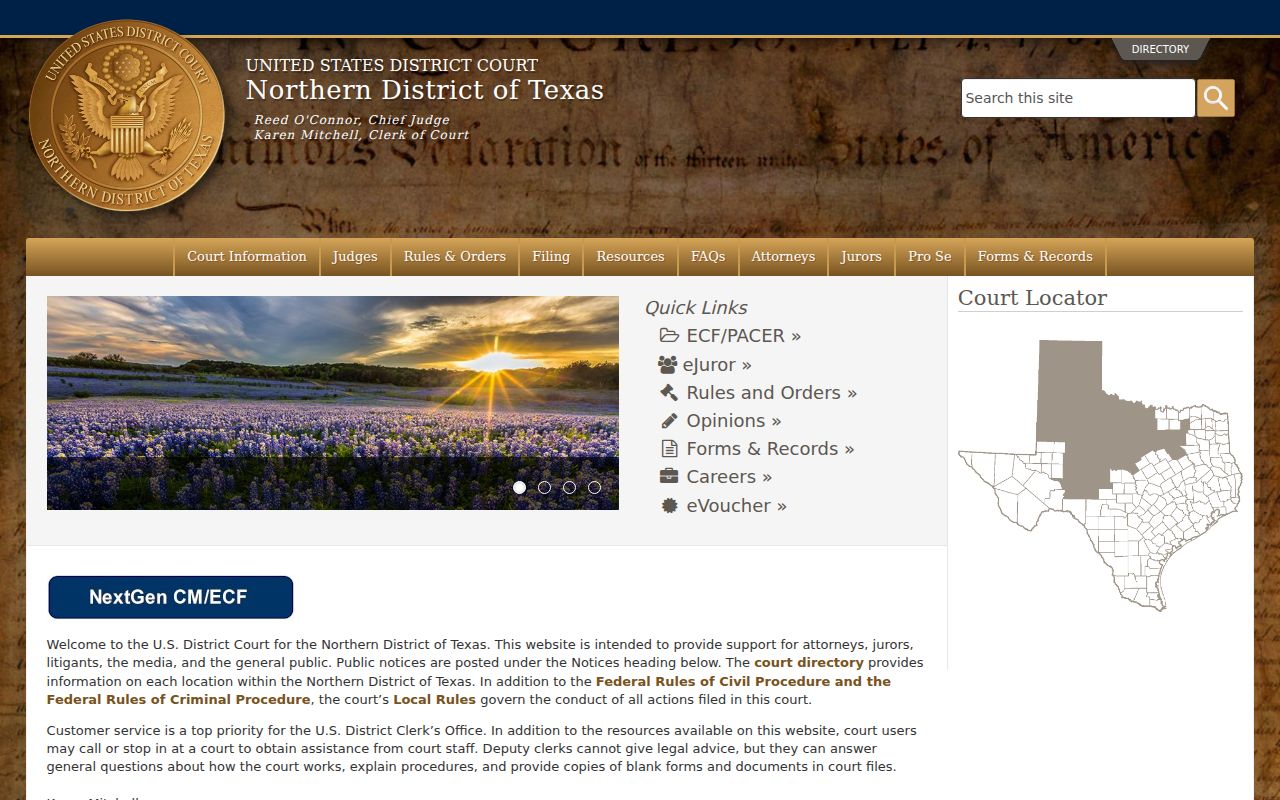
A federal case tied to Castro County does not appear merely because the county clerks were searched. Castro County lies in the U.S. District Court for the Northern District of Texas. PACER supplies federal docket access through an account and the federal judiciary fee schedule, while the Bureau of Prisons locator covers federal custody. Neither channel replaces the county court file or Texas DPS record.
The Northern District of Texas website identifies federal court locations, rules, and official services.
This federal layer is worth checking only when the event involved a federal charge, court, or sentence. A no-result screen in one jurisdiction says nothing conclusive about the other.