
Criminal Cases in the Castro County Courts
Castro County criminal cases are divided by offense level and venue. The Castro County District Clerk keeps felony files for the 64th and 242nd Judicial District Courts. Both district courts serve Castro, Hale, and Swisher Counties, but a Castro filing is requested through the local clerk in Dimmitt. The constitutional County Court has the usual Class A and Class B misdemeanor role. The Justice of the Peace handles fine-only matters, magistrate work, and warrants within its authority. Dimmitt and Hart municipal courts maintain their own city citation dockets.
The court file begins when a prosecutor files an information or a grand jury returns an indictment. It then grows through docket entries, motions, hearing notices, orders, and the final result. A booking charge can change before that file opens. For that reason, the court judgment, not the intake label, controls the final conviction and offense level.
Castro County Court Roles
The fastest way to locate Castro County case records is to match the alleged offense to the court before calling. A felony belongs with the District Clerk. A Class A or B misdemeanor generally belongs with the County Clerk and County Court. A Class C citation may sit with the Justice of the Peace, Dimmitt Municipal Court, or Hart Municipal Court, depending on where it was filed. The Texas Office of Court Administration's live judicial directory can confirm a court and its personnel, but it does not search criminal cases.
The official directory shows why a Castro County search can seem confusing. The district judges have administrative offices outside Dimmitt, yet Castro hearings and files remain part of the local district-court system. The state directory provides a useful visual check before a request is sent.
The Texas court directory shows the official office-finding interface used for that check.
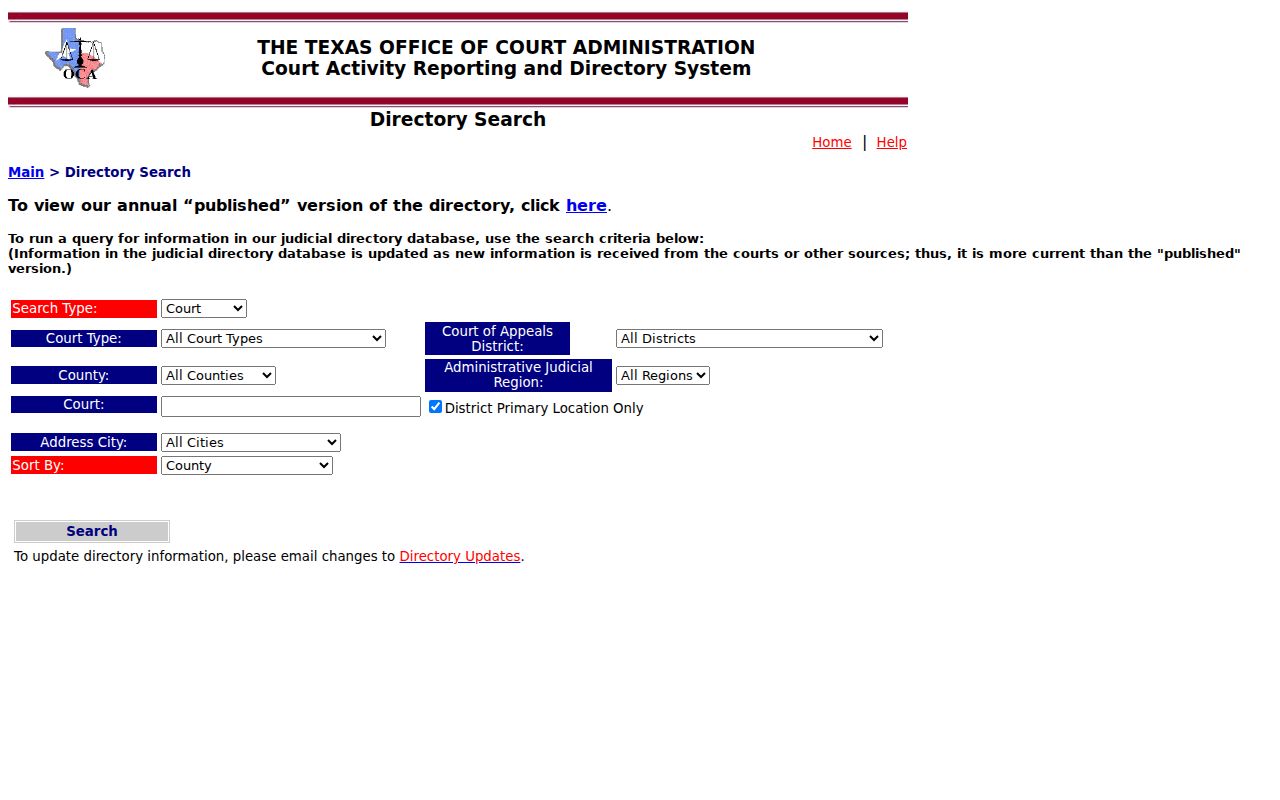
Its result should guide the reader to the custodian, while the custodian supplies the actual case record.
How to Search Case Records
No complete Castro County case portal was verified. A sound search therefore starts with a clerk and treats re:SearchTX as a supplemental electronic channel. Have the full name, likely filing year, case number if known, and offense level ready. Ask the clerk whether the index is electronic, whether an older file is archived, and whether a plain or certified copy is needed.
- Choose the court level: district for felonies, county for Class A or B misdemeanors, and justice or municipal court for fine-only matters.
- Search re:SearchTX after registration, using the available authenticated case criteria. Do not treat a blank result as final.
- Call, mail, or visit the correct Castro County clerk and give the party name, filing range, and case number when available.
- Request the index or docket first, then name the indictment, information, judgment, sentence, bond, order, or other document needed.
- Ask whether the file is restricted or archived, specify plain or certified copies, and request a cost estimate before copying begins.
Public re:SearchTX controls visible without a verified entitlement are limited. The research captured this honest field inventory rather than guessing at private account screens.
| Field or Control | Type | Required | Use |
|---|---|---|---|
| Email or username | Text | Yes for account access | Account credential |
| Password | Password | Yes | Account credential |
| Register | Workflow link | For new users | Creates an account; access and charges can vary |
| Case criteria | Authenticated controls | Not shown publicly | Name and case number are expected; live fields may change |
Castro County Case Clerks
The Castro County District Clerk and County Clerk both publish Room 101 at the Castro County Courthouse, 100 E. Bedford Street, Dimmitt, Texas 79027. They also list the same phone, 806-647-3338, and fax, 806-647-5438. Counter hours are Monday through Thursday from 8:00 a.m. to 5:00 p.m. and Friday from 8:00 a.m. to 2:00 p.m., open through lunch. The shared contact point is convenient, but a requester should still name the court level so staff can route the case correctly.
Castro County Court Clerks
100 E. Bedford Street, Room 101
Dimmitt, TX 79027
806-647-3338
Mon-Thu 8:00-5:00; Fri 8:00-2:00
The District Clerk's official page displays the felony-file counter and its local resources.
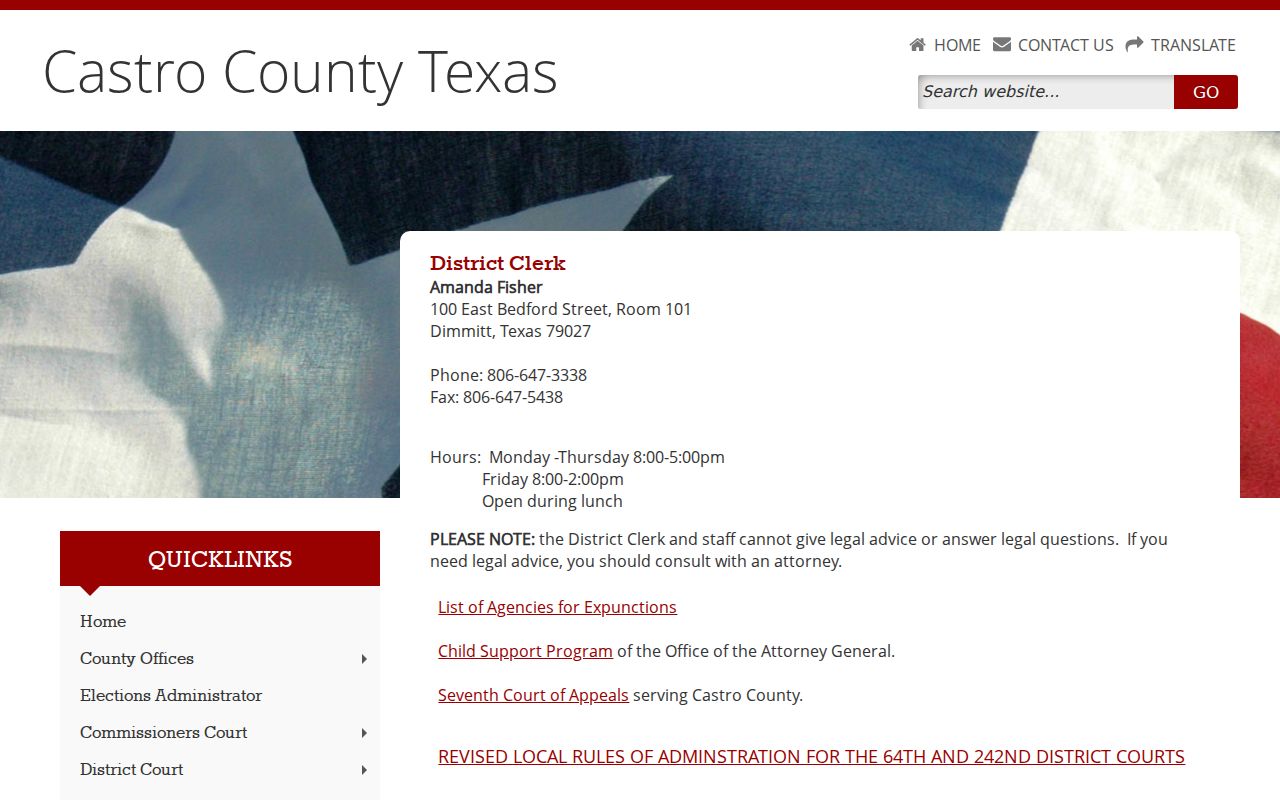
The page confirms where Castro County district case requests and expunction-related filings begin.
The matching County Clerk page identifies the same courthouse counter for county-level records.
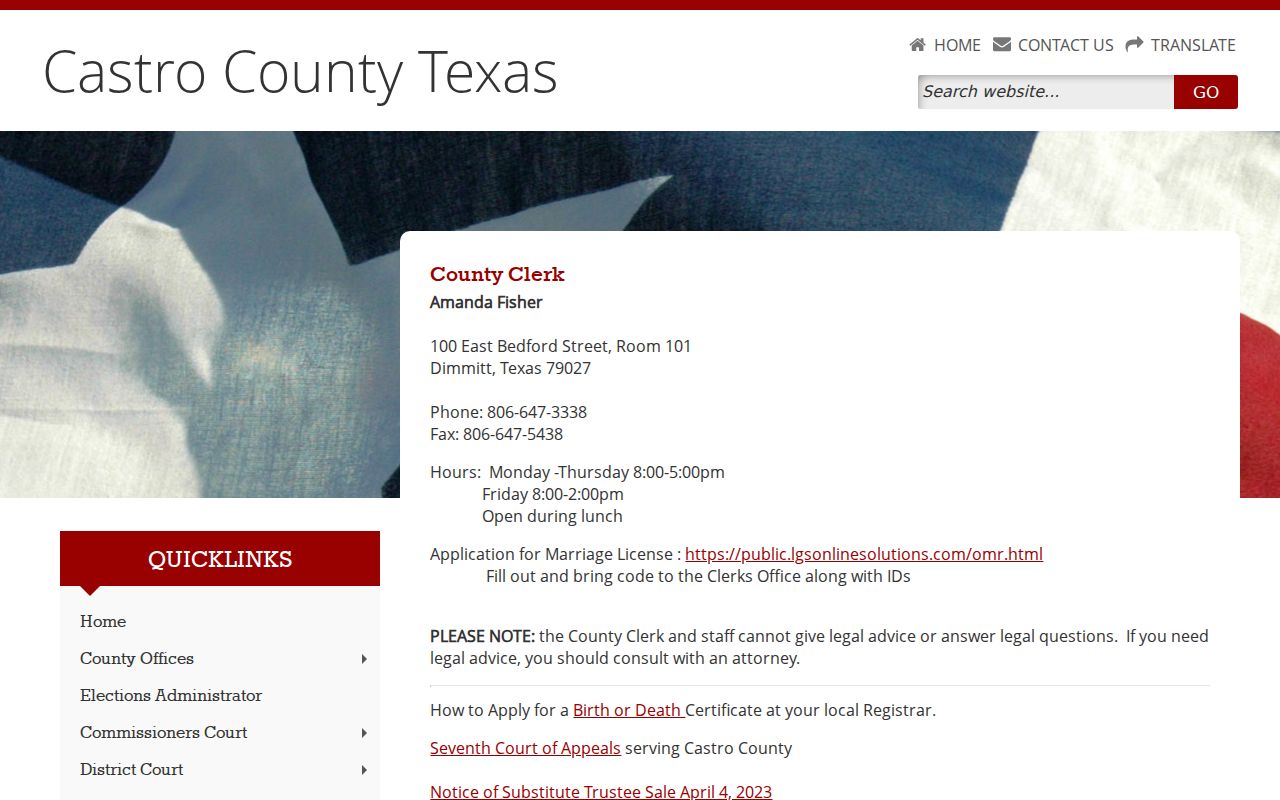
Together, the two pages make clear why the requester must say felony or misdemeanor even when the street address is the same.
Note: Call before travel to confirm the file location, copy price, and whether an older Castro County case has moved to archives.
What the Case File Shows
A Castro County case file records the prosecution after a charge reaches court. Online views can omit protected fields or documents. A complete clerk file may contain much more than a summary screen, including the charging instrument, counsel appearances, motion practice, bond actions, and financial entries. Ask for the docket sheet first when the exact document name is unknown.
| Case number and court | Identifies the clerk file, trial court, case type, filing date, and status. |
|---|---|
| Filed charge | Shows the prosecutor's offense description, statute, degree, and indictment or information date. |
| Parties and counsel | Lists the State of Texas, defendant display name, and attorney appearances, subject to redaction. |
| Docket events | Tracks hearings, motions, pleas, capias entries, orders, and other dated acts. |
| Bond and settings | May show bond type or amount and scheduled hearing dates. |
| Disposition and judgment | Records conviction, dismissal, acquittal, deferred adjudication, or another final result. |
| Sentence and costs | May list confinement, community supervision, fines, costs, restitution, and related terms. |
Dates of birth, Social Security numbers, victim or minor data, and sealed documents should be absent or redacted from public copies. A restricted entry is not evidence that no case exists.
Castro County Case Search Limits
re:SearchTX is an electronic court-record platform, not a promise of one complete Texas trial-court search. Clerk participation, document availability, account rights, and charges can differ. A Castro County criminal case may also predate the electronic index or sit in a local system that the account cannot reach. When the screen returns nothing, check spelling and court level, then contact the clerk.
The re:SearchTX landing page shows the registration gate that comes before its authenticated tools.
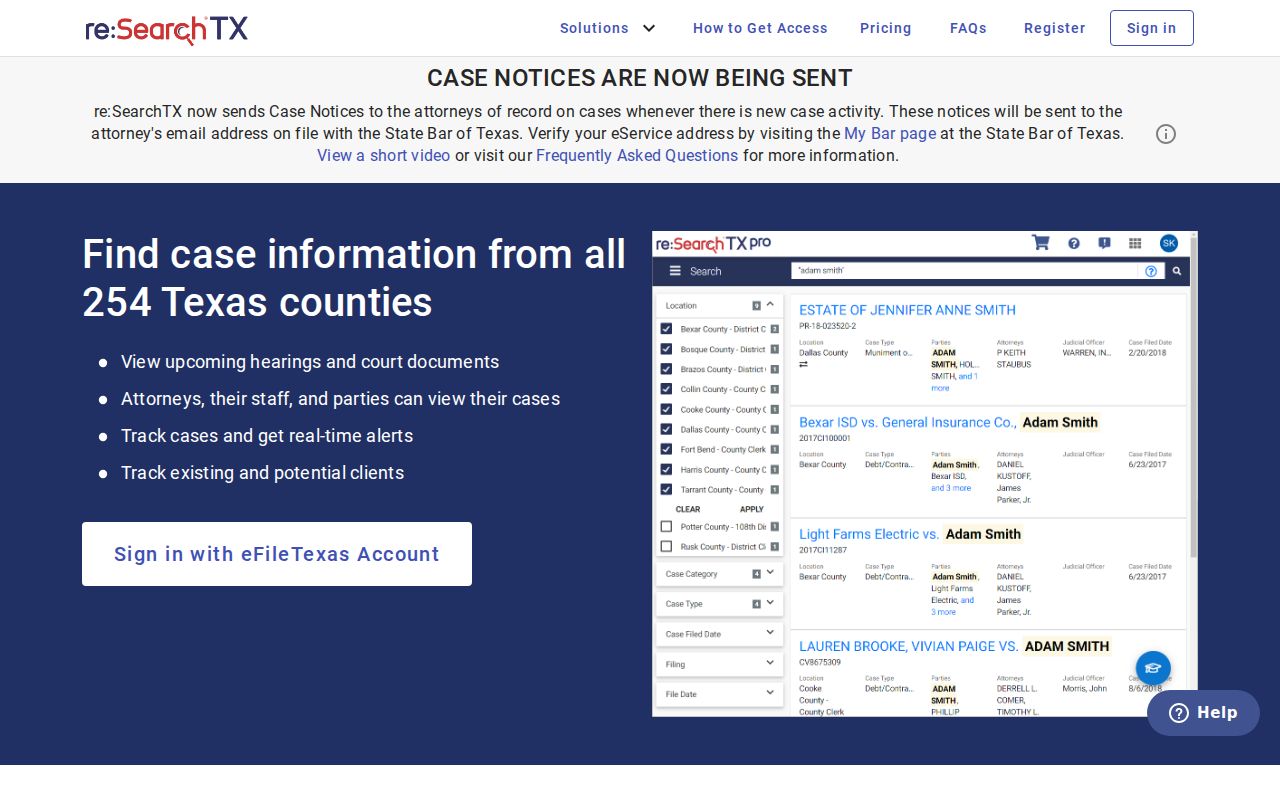
That gate is a key limit: fields, coverage, and documents can vary after sign-in, so no-result claims require clerk confirmation.
Access rule: Texas judicial records follow court-access rules and clerk practice. The Texas Public Information Act does not turn every court file into an executive-agency records request.
Stages of a Criminal Case
A Castro County criminal case can start with an arrest or summons. After a custodial arrest, a magistrate gives the warnings required by Article 15.17 without needless delay and within the statute's outer 48-hour limit. The prosecutor then reviews the evidence. A misdemeanor may proceed by information, while a felony normally requires a grand-jury indictment. The court records arraignment, pretrial settings, a plea or trial, the judgment, and the sentence. Appeals or later supervision actions can add more entries.
Case flow: Charges Filed → Arraignment → Pretrial → Plea or Trial → Disposition → Sentencing
The order explains why a first jail charge and the final Castro County judgment may differ without either record being false. Each document reflects a different stage.
Reading Castro County Case Entries
Docket terms are short labels for acts in the case. An indictment is the felony charge returned by a grand jury. An information is a prosecutor-filed charging paper often used for a misdemeanor. A capias directs an arrest in connection with a case. A disposition is the recorded outcome, while deferred adjudication means the court delayed a finding of guilt during community supervision.
- Arraignment
- The proceeding at which the filed charge is addressed and a plea is taken.
- No-bill
- A grand jury decision not to indict the charge presented to it.
- Dismissal
- The end of a charge without a conviction on that count.
- Acquittal
- A not-guilty result after trial.
- Judgment
- The court's formal written result, which controls over a prior arrest label.
For a fine-only matter, the Castro County Justice of the Peace page provides the official court contact.
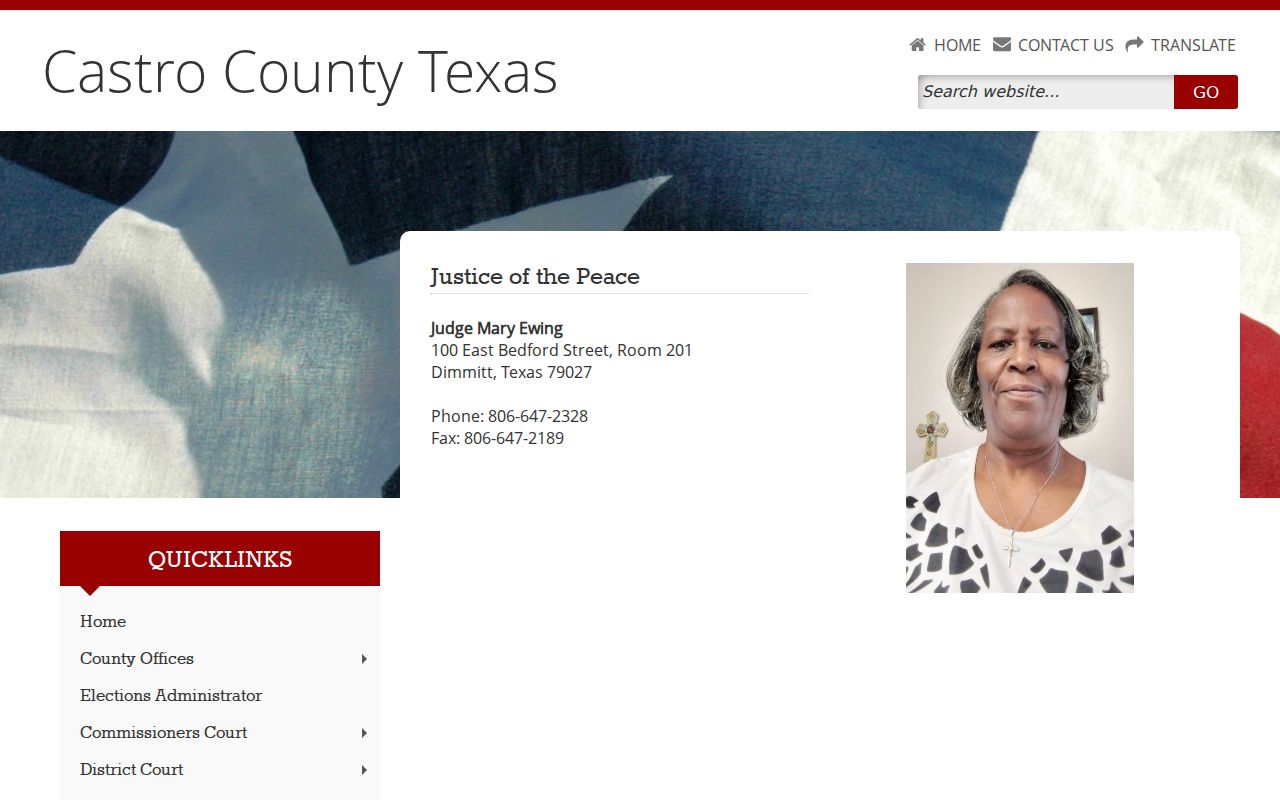
The image represents a separate local docket channel, not a substitute for district felony or county misdemeanor files.
Access & Restrictions
Public access does not make every part of a Castro County case file open. Clerks redact Social Security numbers, driver's-license data, protected financial details, victim information, and minor identifiers where law requires. Juvenile cases and sealed records can be confidential. An expunction order under Chapter 55A or an order of nondisclosure under Government Code Chapter 411 can also change what the public sees.
Ask the clerk whether the record is sealed, redacted, archived, or outside that office when a known case is missing. A clerk can provide existing records, but does not have to create a custom legal history. The broader Castro County criminal history overview explains why a court file, jail entry, and DPS repository cycle should not be treated as the same record.
Note: A public screen may hide protected content while the originating Castro County clerk still retains the official case under access rules.
Federal Cases Beyond Castro County Courts
A federal prosecution arising in Castro County does not belong in the county clerk file. Castro County lies in the Northern District of Texas, Amarillo Division. PACER provides federal dockets and documents after registration. Its current judiciary pricing is generally ten cents per page with a three-dollar document cap, subject to exceptions, and quarterly charges of thirty dollars or less are waived. Readers should verify the current schedule before use.
The official PACER service shows the account and federal case-access route.
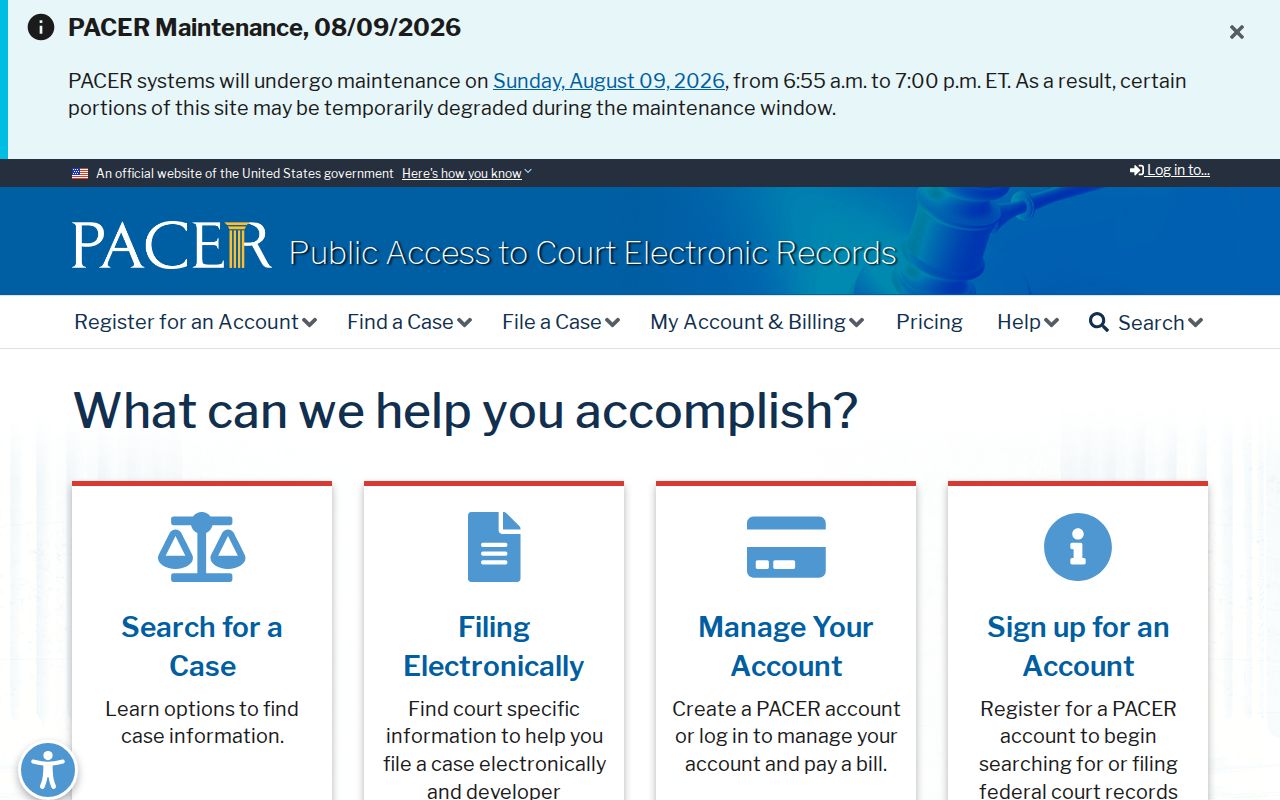
This federal layer belongs beside, not inside, a Castro County court search because the two systems have different clerks and case numbers.